
Cantilever rack stores the loads pallet rack can't: lumber, pipe, bar stock, tubing, furniture, and anything long, awkward, or oversized. AMH supplies new and used cantilever racking, designs the layout around your product and your forklifts, and installs it with our own in-house crews.
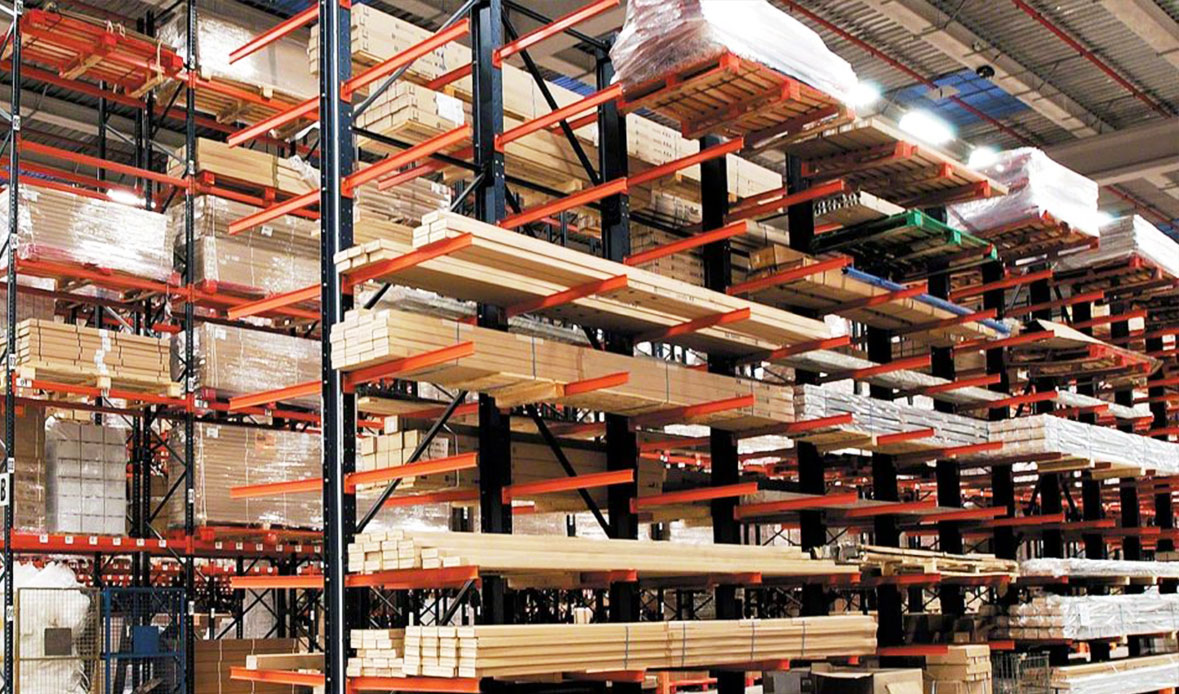
A cantilever rack is built from three parts: a vertical column on a heavy base, and arms that extend out from the column like branches. There are no front uprights and no beams boxing in each level, so the entire face of the rack is open. That open face is the whole point: a forklift (or a sideloader) can pick a 24-foot bundle of pipe straight off the arms without threading it between columns.
If your product fits on a pallet, pallet rack is almost always the cheaper answer. Cantilever racking earns its keep when the load is longer than a pallet, varies in length, or would be damaged by vertical obstructions: lumber, steel, pipe, conduit, trim, sheet goods on cradles, furniture, and oversized SKUs that never sit square on a 40x48 footprint.
Both types work the same way. The difference is the steel they're made from, and that decides how much abuse and how much weight they take.
The same logic we apply to used vs. new pallet rack applies here. Cantilever racking is heavy steel with no moving parts: properly inspected used rack carries the same capacity as comparable new material, at a meaningful discount and without the mill lead time.
You need arms in the ground this quarter, or the budget is fixed. Used cantilever rack from our $10M+ owned inventory ships without a manufacturing queue.
Exact arm lengths, specific column heights, seismic documentation, or a galvanized outdoor system spec'd from scratch. New rack is built to your drawing, not matched from stock.
Used columns and bases with new arms cut to your product, or new rack for the heavy bay and used everywhere else. We quote it as one hybrid system.
Cantilever capacity is a system number, not just an arm number. Four things drive it, and getting any one wrong either wastes money or overloads steel. We run these numbers on every quote. The same load principles govern selective racking too, and our pallet rack capacity guide breaks down how deflection, gauge, and load distribution set what a system can really hold.
Not sure what your product weighs per foot? Send us the spec sheet with your quote request and we'll do the math.
Cantilever rack installation is unforgiving: bases must be anchored plumb and level, arms must be pinned at consistent heights, and aisle widths have to match the equipment picking the loads. AMH crews are in-house, not brokered out, and they've stood up storage systems in 1,200+ projects since 1979. Layout comes from our warehouse layout planning team; anchoring, permits, and inspection are handled the same way we handle every rack project: 98% first-pass permit approval.
Adding a floor above your cantilever bay, or mixing cantilever with pallet rack and shelving? We design the whole system together, including warehouse mezzanines and custom steel fabrication for anything the catalog doesn't cover.
Their team was professional throughout the project and brought forward creative, cost-effective solutions that added real value. They executed each phase on schedule and were highly flexible when we needed to make last-minute adjustments.Brendan Tuohy, VP Distribution & Transportation, Mueller Streamline Co.
Cantilever racking is a storage system with no front columns. Loads rest on arms that extend out from a vertical column set on a heavy base, leaving the entire face of the rack open. That open face is what makes it different from pallet rack: there are no uprights or beams boxing in each level, so a forklift or sideloader can place and pull long material end-on without threading it between columns. It is the standard system for anything long, awkward, or oversized, and it is usually the wrong system for palletized goods.
It comes down to the shape of the load, not the weight. If your product sits on a pallet and fits inside a bay, selective pallet rack stores more of it per square foot and costs less per position. If your product is longer than a bay, will not sit square on a pallet, or has to be picked from the side, cantilever rack is the answer. Plenty of warehouses run both: pallet rack for the palletized SKUs and a cantilever row along one wall for the long stock.
Capacity is rated per arm, per column, and per base, and the lowest of the three governs. Roll-formed arms typically carry a few hundred to a couple of thousand pounds each; structural arms carry substantially more and are the usual choice for steel, heavy pipe, and outdoor service. Because the column and base have to carry every arm above them, total column capacity is what most often limits a design. Send us your load weights, lengths, and how many levels you need and we will spec the full system rather than quote arms alone.
Yes, when it's inspected and matched correctly. Capacity comes from the column, base, and arm configuration, not from the age of the steel. We inspect used cantilever racking before it ships and only pair components designed to work together.
Structural cantilever rack is common in outdoor lumber and pipe yards. For outdoor service we recommend galvanized or heavy-coated systems and account for wind load in the design.
Per arm, per column, and per base, as a system. A common mistake is buying arms rated for the load while the column or base is undersized for the total. Send us your load weights and lengths and we'll spec the full system.
Both. AMH designs, supplies, and installs with in-house crews, and we handle permits and engineering documentation as part of the project. One contract, one responsible party.