
When people think about pallet rack capacity, they usually look for one number: the beam rating. It feels straightforward. If the beam says 5,000 pounds, the assumption is that the whole system is covered. In practice, capacity is a combination of structural behaviors that depend on how loads move through beams, uprights, connectors, and the slab. Understanding how those pieces interact is the only way to know what your racking can truly support.
Why rack capacity is more complicated than it looks
Pallet racking is more complex than it appears. Its performance depends on stiffness, geometry, steel thickness, and how loads are applied. Three components define the system:
- Beams that carry pallet weight
- Uprights that support vertical forces
- Connections that manage rotation and hold everything in place
Change any one of these and you change the capacity of the entire bay. Two bays that look the same can carry very different loads if their beams, frame gauges, or connectors differ even slightly.
Beam deflection: the most misunderstood part of capacity
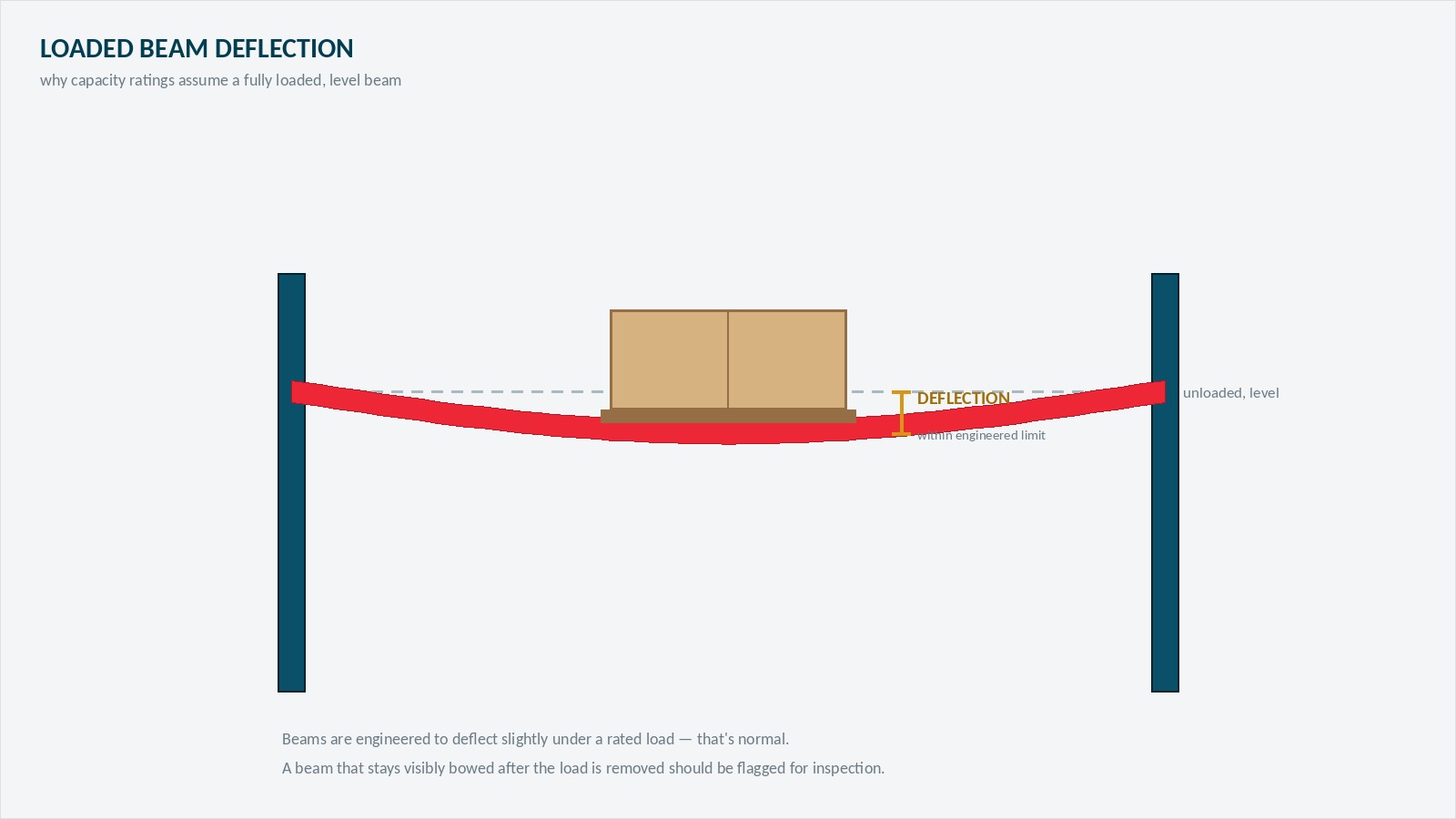
Beams are designed to flex. This surprises many operators, but controlled deflection is normal behavior in steel.
What deflection actually means
When you load a beam, it bends downward. Engineers limit how much bending is acceptable because too much deflection affects stability, pallet seating, and how the rack feels to the lift operator. For most selective rack the industry uses a deflection limit of L/180. On a 96-inch beam, that is roughly half an inch. If a beam deflects past its limit it is not considered safe or compliant, even if the steel has not yielded.
What causes beams to deflect beyond their limit
Even a properly rated beam can exceed its allowed deflection if:
- Pallets are heavier than expected
- Pallet weight is not spread evenly
- The beam is damaged, or rotated due to connector issues
Excessive deflection does not always lead to immediate failure, but it signals that real loads differ from engineered loads. That gap is where problems start.
Upright gauge and frame behavior
If beams carry the pallet weight, uprights carry the combined weight of everything above them. Upright capacity depends on column profile shape, steel gauge, bracing pattern, frame height and depth, and footplate design and anchor strength.
A small change in gauge can produce a large change in capacity. A damaged upright can reduce column strength dramatically, especially in the lower 24 inches where forklifts strike most often. This is one of the most common structural risks we see during inspections. Our repair programs address exactly these conditions with engineered reinforcement that restores upright performance while the rack stays loaded.
Load distribution: the real world is rarely uniform
Manufacturers test rack components using uniform loads. Warehouses rarely load racks that way.
Point loads
Most pallets do not distribute weight evenly. CHEP pallets with broken slats, plastic pallets with narrow runners, metal bins with feet, and overloaded totes all create concentrated pressure points on the beams.
Off-center loads
If a pallet sits too close to the beam connector, local bending stress increases and can deform the steel.
Uneven loading across beam levels
A single bay might have a top level loaded past its engineered weight, a partially loaded middle level, and an empty bottom level. That imbalance changes how forces travel through the uprights and can increase sway or uplift at the connectors. Small changes in how pallets sit often lead to large changes in how the rack performs. Operators rarely notice; engineers always account for it.
How engineers actually determine capacity
Rack capacity calculations combine testing and structural modeling. Engineers look at:
- Beam bending and shear stress
- Deflection under uniform load
- Column buckling and frame stiffness
- Anchor pull-out and shear strength
- Sway behavior in back-to-back rows
- Seismic forces where required
These calculations are sensitive to geometry. An upright one gauge thinner or one inch taller can have a very different rating. That is why mixing components voids most certifications, and why we verify weight capacities as part of every warehouse layout plan and seismic review.
Common mistakes that lead to capacity problems
Warehouses run fast, and operators rarely think about the structural mechanics of the racks they use every day. The most common capacity issues come from:
- Assuming wire deck increases beam capacity
- Relying on damaged uprights
- Overloading one level while leaving others empty
- Running lift trucks that exceed original design assumptions
- Using nonuniform pallets on beams designed for flat loads
- Reconfiguring warehouses without checking the impact on capacity
These issues do not always cause immediate failure, but they do weaken the margin of safety. Our repair case studies show how widespread upright damage can be, and how much money strengthening racks saves over replacing them. On one project, repairing 35 damaged uprights saved more than $30,000 with far less downtime. Another saved more than $550,000 while cutting the project duration in half.
Maintaining safe rack capacity
Good capacity management is not about changing beam sizes every year. It is about controlling the conditions that matter.
- Inspect racks regularly. Loose anchors, bent columns, and damaged beam connectors are early warnings. We provide free inspections and ongoing preventive maintenance to help catch these early.
- Repair instead of replacing. Engineered repair kits restore capacity, reduce downtime, and keep steel in service. We recondition and repurpose more than 100 million pounds of steel a year.
- Review capacity when SKUs change. Heavier products or new pallet types often require updated ratings.
- Confirm compatibility when reconfiguring. Changing beam elevations or mixing used components can alter load paths in unexpected ways.
- Update layouts when equipment or aisle patterns change. A new lift-truck fleet or modified picking operation can put forces on the rack it was never designed for.
Key takeaway
Rack capacity is not just a number on a sticker. It is a structural relationship between beams, uprights, connectors, and the loads that move through them. Understanding how deflection, gauge, and real load distribution work helps you keep a safer warehouse and protect long-term rack performance.