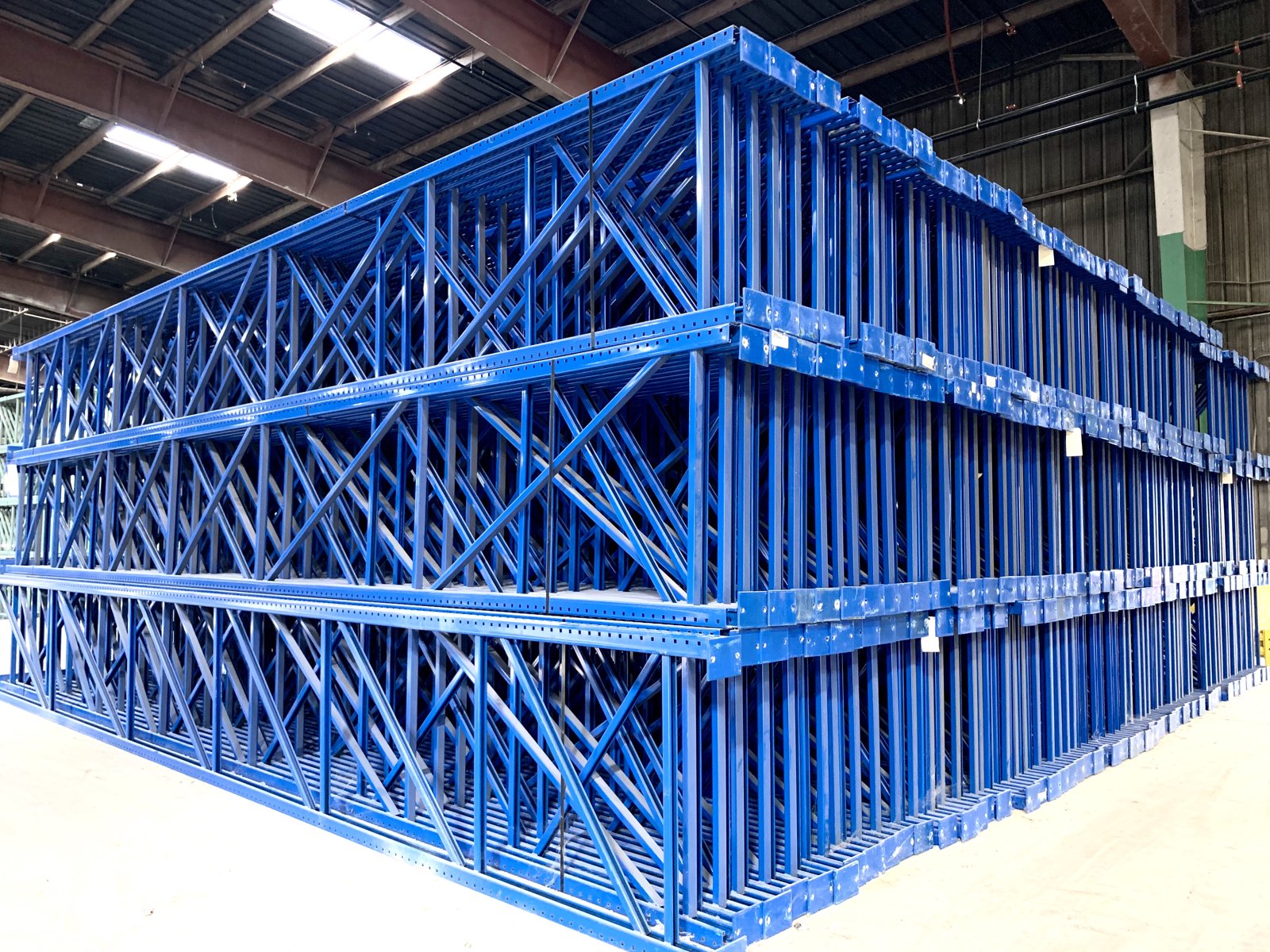
Used rack isn't a compromise. It's often the stronger material. Older-generation domestic rack is frequently heavier gauge than what ships new today, and our owned inventory ships in days instead of the 8+ weeks typical for new orders, at up to 50% less cost on an equivalent per-bay basis.
Domestically manufactured new rack has, in many cases, gotten lighter over time as manufacturers reduce steel gauge to stay price-competitive. It ships, installs, and passes inspection, but it isn't always the same product it was 20 years ago. Used rack from large facilities built in the 1990s and 2000s is often heavier gauge, more robust, and genuinely superior to what you can order new today.
On a mid-size project, $200,000 to $500,000 in rack, that gap funds additional bays, upgrades elsewhere in the facility, or simply preserves capital.
New rack lead times from domestic manufacturers typically run eight weeks or longer. If your lease start date is fixed, in-stock used rack removes that risk entirely.
When we own inventory outright, that material was purchased before any current steel price movement, you're insulated from the market in a way new orders aren't.
Rack that came out of a well-run distribution center with a regular inspection program, disassembled professionally, and stored indoors is a fundamentally different product than rack that sat outside or came from a facility with a history of forklift damage. A reputable dealer knows the difference and prices accordingly. Curious what your project saves beyond the invoice? Run the environmental savings calculator. The same inspection standards power our repair division, see how we assess damage at RackRepair.com.
Want the full decision framework? Our free Pallet Rack Guide covers it, no email required.
Download the Guide →AMH did everything for us. They equipped us for growth and we didn't miss a beat. And on top of all that, we paid half the price of new rack.Shawn McGhee, President and Founder, Hollywood Feed
Used rack enters the market through three main channels, and each produces a different kind of inventory: large facility decommissions (significant volume of high-quality material in a short window), company closures and liquidations (quality varies, we evaluate and sort, buying selectively), and reconfiguration projects (smaller volumes, usually good condition). Have rack or equipment you're looking to sell? We're the buyer: see Sell Your Equipment. Our West Memphis location gives us freight advantages extending roughly 500–600 miles, the Southeast, Texas, the Midwest, and beyond, keeping delivered cost competitive across that whole radius.
Used rack deserves the same protection as new: every rack purchase can include the Rack Safety Maintenance Plan sign at time of purchase and your first 6-month inspection is free.
Ask About the Plan →Yes, when it has been properly inspected, refurbished where needed, and installed correctly. Used rack meets the same OSHA and RMI standards as new rack; the material standard is performance-based, not age-based. The key is buying from a dealer who has physically inspected the material and can document its condition and load ratings.
Compatibility depends on ceiling height, column spacing, aisle width, and forklift type. We'll ask for these measurements before quoting, if a vendor doesn't, that's a red flag. The major dimensions that drive configuration are clear height, building column spacing, and your forklift's turning radius.
For used rack from in-stock inventory, a small to mid-size project (1,000 to 5,000 pallet positions) can typically go from quote to installed in two to four weeks. Larger projects take longer due to installation crew scheduling and permit timing.
In most cases, yes. Major rack profiles from established manufacturers (Interlake, Frazier, Ridg-U-Rak, Unarco, Mecalux, and others) have largely standardized connecting dimensions, and beams from one brand are often compatible with uprights from another. Our owned inventory base gives us a strong position to fill add-on orders.