
When you are ready to add storage, one of the first decisions you face is the rack itself. Many companies in North America use welded rack. Much of Europe and the rest of the world prefers bolted rack. Both are proven ways to build a storage system, but they behave differently on structural integrity, durability, customization, and the cost to produce, ship, install, and repair. Here is the honest comparison.
Welded vs bolted: what is the actual difference?
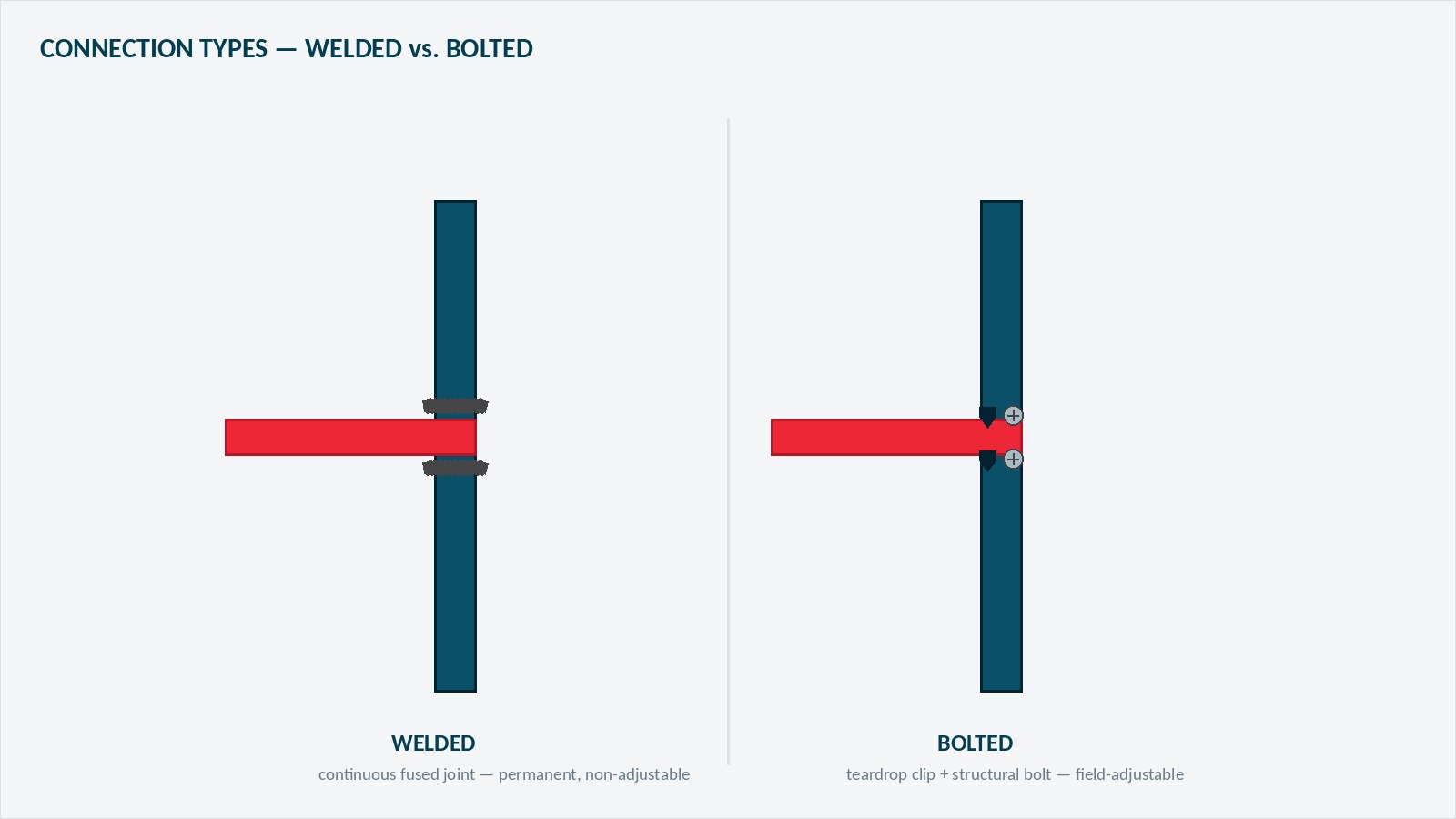
A welded frame is built by welding the cross-bracing or struts directly to the frame columns, usually attaching to the open lips of the C-shaped column channel. A bolted frame connects the struts or brace panels to the sides of that same C-shaped channel using pre-drilled holes and hardware. The columns and beams look nearly identical. The difference is entirely in how the frame is held together.
Structural integrity
Neither system claims to be the strongest in every scenario, and the construction method matters for how the frame handles applied force. Bolted rack most closely resembles how large warehouses, retail structures, and skyscrapers are built: steel posts and beams bolted together to form the underlying structure.
Flexibility and bracing
Bolted bracing members are not rigidly fixed to the column lips. They connect with a single bolt, which lets them absorb applied force without transferring it across the joint. That flexibility means the frame can take a forklift impact, a seismic event, or a record wind gust without the force being carried through and breaking something. It makes for a sturdy, forgiving structure.
Welded bracing members are rigid and fixed. They cannot flex in response to subtle earth movement and bending forces, which makes them more likely to break during a seismic event. That would seem to make bolted the clear choice in seismic zones, but it is not settled: some engineers argue welded systems can be stronger when they use offset or slope-back front legs, or full-depth seismic base plates that let the beams sit at ground level. The right answer depends on your building and your seismic zone, which is exactly the kind of thing a professional should evaluate for your space.
Durability
A common myth about bolted rack is that the bolts loosen over time and need re-tightening. In practice, these locking bolts are serious hardware. Serrated lock nuts and limited bolt threads prevent overtightening, and once tightened they are effectively locked in place. They will not back out, even if the whole assembly ships in one piece. When rack ships in multiple pieces, the installer torques the lock nuts on site.
Damage tolerance is where bolted really separates itself. If a bolted frame takes damage, it can keep supporting the structure until the repair happens. A damaged welded frame can collapse, which makes damaged welded uprights far more dangerous than damaged bolted uprights. If a lock nut ever came off, or a column or strut was struck, the bolt still holds the system. A bad weld, on the other hand, undermines the whole frame, and without prompt attention it can bring the structure down and injure your people.
Customization
Customizing a bolted frame is simple: cut the columns to the right size and adjust the bracing during assembly. Customizing a welded frame is harder. The manufacturer has to remove a diagonal and/or horizontal brace, cut the columns, and re-weld the bracing. That is slower, more expensive, and sometimes not even possible within a client's specs.
Cost of production, shipping, and installation
Bolted rack generally costs less to produce, ship, and install. The components are nearly identical, but bolted frames skip the added labor and material of welding. Where a galvanized finish is required, as in pharmaceutical and food handling, welded systems cost more because the uprights cannot be galvanized until after the frame is built.
Shipping is where the gap gets wide. Welded uprights ship pre-assembled and take up far more space. A 40-foot truck of welded uprights maxes out around 20,000 to 25,000 pounds. That same truck carrying "knocked down" bolted uprights can hold up to 48,000 pounds, roughly double the equipment per trip. Fewer trips saves real money. Bolted rack is also easier to unload, handle, and reconfigure on site, which keeps installation labor down.
Ease of repair
With bolted rack, a bent or damaged brace simply unbolts and gets replaced with new bracing. You can make a visual inspection, identify the problem, and decide on a fix. If the frame uses a bolted base plate, a strut or column can be repaired in the field with little more than a ratchet and a band saw.
Welded joints are less forgiving. A joint can look fine from the outside while hiding a weak connection that threatens the whole structure. Diagnosing damage in welded uprights usually means further testing, and the repair often involves torching off the damaged area and building expensive custom replacement parts. When rack does get damaged, our repair division handles both, but the bolted design is simply easier and cheaper to bring back to spec.
So which should you buy?
There is no universal winner. Bolted rack tends to win on shipping cost, customization, damage tolerance, and repair. Welded rack has its place, particularly in certain seismic designs and high-volume standardized layouts. The right call comes down to your building, your seismic zone, your load specs, and your budget. That is a conversation worth having with someone who will look at your actual space rather than sell you a single answer.