
Drive-in rack is one of the most effective systems for warehouses that value storage density over selectivity. Unlike conventional pallet racking, drive-in racks let forklifts enter the structure itself to place and retrieve pallets in deep lanes. That cuts the number of aisles you need and packs far more pallet positions into the same footprint. We design and install drive-in systems that balance density, safety, and throughput for high-volume operators.
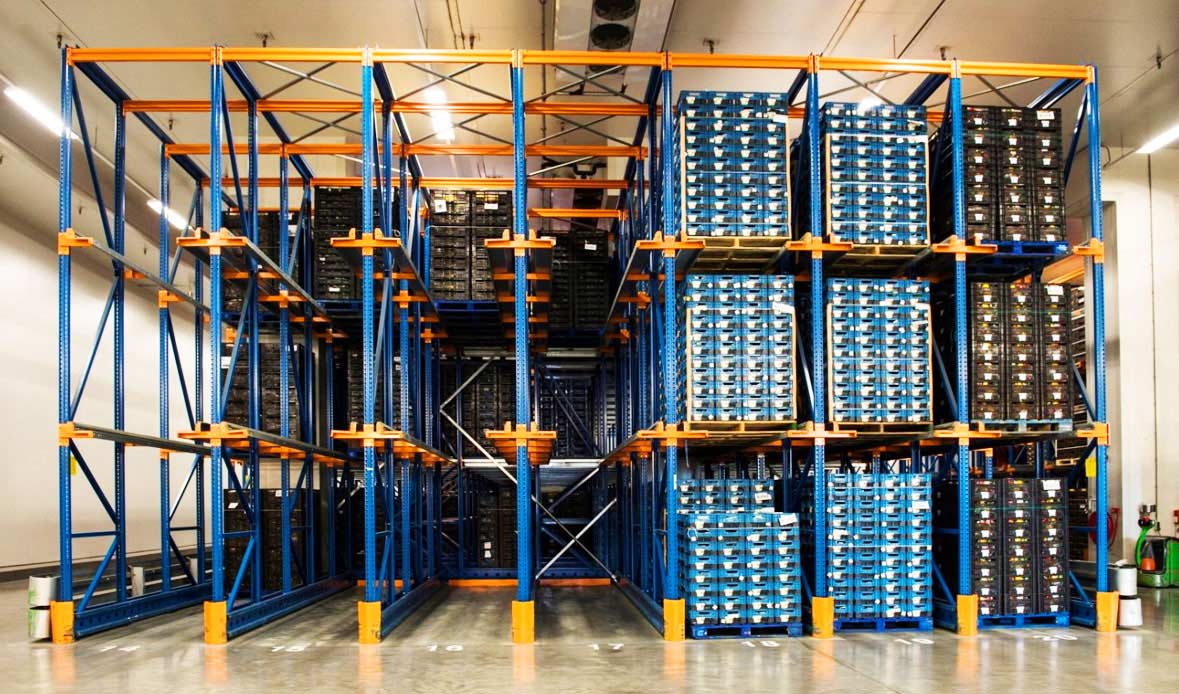
How drive-in racks work
Drive-in racks operate on a last-in, first-out (LIFO) principle. Pallets sit on rails that run the depth of the rack, so forklifts drive directly into the system to place or remove loads. Eliminating aisle space consolidates inventory into fewer, deeper lanes.
- Storage depth: lanes typically hold 2 to 10 pallets deep.
- Entry points: single-entry systems allow forklift access from one side; double-entry systems open both ends for even greater density.
- Best fit: high volumes of the same SKU, or products with longer shelf life where strict rotation is less critical.
Benefits of drive-in racks
1. Maximum storage density
By eliminating multiple aisles, drive-in racks can increase storage capacity by up to 75% compared to selective racking. That makes them a top choice where floor space is at a premium.
2. Cost efficiency
Greater density means a lower cost per pallet position. Instead of expanding a facility or leasing more space, you unlock capacity inside the footprint you already have.
3. Ideal for bulk storage
Drive-in racks excel where large quantities of the same product are stored. Food and beverage, cold storage, and raw-materials distribution all benefit from bulk storage efficiency.
4. Flexibility for seasonal or buffer inventory
For operations with seasonal peaks or large buffer stocks, drive-in racks absorb inventory swings without a permanent facility expansion.
Considerations before you commit
Drive-in racks deliver unmatched density, but they demand thoughtful design and operational discipline.
- Forklift maneuverability: operators must be trained to enter and exit lanes safely. Our designs account for clearances and impact protection to reduce damage.
- Load rotation: because the system is LIFO, it is not ideal for perishable goods that require strict FIFO rotation.
- Rack protection: column protectors, guide rails, and reinforced uprights are essential to extend rack life and cut maintenance cost.
- Fire code and safety compliance: we make sure systems meet OSHA and local fire-code requirements, particularly in high-piled storage.
Case example. A cold-storage distributor partnered with us to redesign its warehouse as demand outpaced capacity. Replacing selective racking with drive-in racks raised pallet positions by 68% with no added footprint. The system was engineered 7 pallets deep and 4 levels high, tailored to frozen-food pallets in uniform SKUs. The result: more than $1.2M in avoided real-estate cost, better order consolidation, and a facility lifespan extended by over a decade.
Why choose AMH for drive-in applications
Drive-in rack is not a one-size-fits-all product. We approach every install with engineering precision:
- Customized design: every system is built to your pallet dimensions, load weights, and throughput goals.
- Fabrication and installation: in-house fabrication and experienced installation crews mean speed, quality, and compliance.
- Long-term ROI: protective accessories, maintenance programs, and future-proofing extend system life and lower total cost of ownership.
For high-volume operators, especially in food, beverage, and cold storage, drive-in rack is a smart investment in space efficiency. It is a proven way to maximize density, cut cost per pallet position, and extend the useful life of an existing facility.